Legislative News
December 2025 OSHGAC Newsletter
Legislative Update
Session Schedule & Priorities
The 136th General Assembly is approaching its halfway mark with the closing of 2025. The legislature will return in 2026 by late January (Senate) and February (House).
Next year, the 2026 election will bring significant changes, with gubernatorial candidates Vivek Ramaswamy (R) and Amy Acton (D) competing for office. Additionally, the November election ballots will have candidates for all statewide offices, 99 House seats, and odd-numbered Senate districts.
Key Bills in Progress
House Bill 523 & House Bill 205 - Future Educator Support Act (OSHGAC Supports)
- HB 523 is the reintroduced version of HB 205 with bipartisan sponsorship (Representatives Sean Brennan & Gayle Manning).
- The bill has been referred to the House Education Committee but has not yet been scheduled to receive a first hearing.
House Bill 461 - Correctional Facility Communication Access (OSHGAC Supports)
- HB 461 would require county and municipal correctional facilities and state correctional institutions to provide teletypewriters for deaf/hard of hearing or severely speech impaired inmates at no cost.
- Following a meeting in November with OSHGAC members and the bill sponsor, Representative Terrance Upchurch, OSHGAC is working to gather information on the current technology available in correctional facilities and will remain in contact with Representative Upchurch and his staff.
House Bill 453 – Coverage and Practice of Applied Behavior Analysis Therapy (OSHGAC Monitoring)
· HB 453 would remove the existing age and service restrictions for health insurance coverage of screening, diagnosis, and treatment of autism spectrum disorder.
· As written, the bill would also do the following:
o Require third-party payers to reimburse applied behavior analysis service providers for performing adaptive behavior assessment and treatment procedures at a minimum of 100% of the Medicaid fee schedule for those assessments and procedures.
o Set payment rates for applied behavior analysis therapy services under Medicaid managed care at 100% of the rate for those services under Medicaid fee for-service in fiscal year 2027.
o Establish a new professional credential for eligible individuals studying to become certified behavior analysts and permits those individuals to provide applied behavior analysis treatment temporarily while awaiting examination results and be reimbursed by health plan issuers for those services.
· The bill had its first hearing in the House Insurance Committee in November and received positive initial feedback from committee members.
· OSHGAC will continue to monitor the legislation, although it will not be a main priority for the group.
Draft Legislation - Regarding insurance coverage for augmentative and alternative communication tools
· Last month, Senator Casey Weinstein shared a draft piece of legislation not yet introduced regarding insurance coverage for augmentative and alternative communication (AAC) tools.
· The bill, as drafted, would require health benefit plans to provide coverage for the full cost of necessary AAC tools every three years for a covered person 22 years old or younger, as well as the full cost of any necessary repairs or damage to all AAC tools with no limit.
· OSHGAC members discussed the legislation and noted most insurance denials are rare, suggesting focus should shift to addressing copay barriers and defining covered device types.
· OSHGAC will reach out to Senator Weinstein and try to set up a meeting to discuss the legislation and make recommendations/suggestions.
Other Updates
- CMV Screening: OSHGAC submitted letter to Ohio Department of Health suggesting the Department adds CMV screening to list of required newborn screenings. No responses have been received at this time.
- ASLP Interstate Compact: Following our November meeting, OSHGAC reached out to the Ohio Speech and Hearing Professionals Board (OSHPB) to inquire about provider reimbursements under the compact and general compact updates. In response, the OSHPB shared that Ohio's participation in the compact has been delayed until February 2026. West Virginia and Louisiana are the first and only active states in the compact currently. On the insurance question, the OSHPB shared that providers should contact insurance companies directly about coverage across state lines.
- Newborn Hearing Screening Concerns: It was discussed that the Ohio Department of Health (ODH) has reportedly lost agency staff responsible for follow-up calls to families with failed newborn screenings. ODH has not yet replaced the position due to “lack of resources;” potentially impacting early intervention referrals. OSHGAC will attempt to gather more details on the situation and engage in the issue if there is an opportunity to do so.
Upcoming Actions
- Schedule stakeholder meeting with Senator Weinstein on draft AAC legislation
- Gather information on ODH/newborn screening issue
- Monitor for potential LEAD K initiatives in Ohio
November 2025 OSHGAC Newsletter
Legislative Update
Session Schedule & Priorities
The Ohio legislature will wrap up legislative business for 2025 in just a few weeks. With congressional redistricting settled, priorities for the legislature primarily remain:
• Property Tax Reform: Efforts to prevent a 2026 ballot initiative that would abolish property taxes and provide property tax relief
• Marijuana & Hemp Legislation: Regulating intoxicating hemp products is a priority of both lawmakers and Governor DeWine
On redistricting, a new congressional map was unanimously cleared by the Ohio Redistricting Commission on October 31, 2025. The new map gives a potential 12-3 lean towards Republicans for Ohio's 15 congressional districts. The unanimous adoption of the new map keeps the lines steady through the 2030 election, providing predictability to both candidates and voters.
Key Bills in Progress
House Bill 523 & House Bill 205 - Future Educator Support Act (OSHGAC Supports)
• HB 523 is the reintroduced version of HB 205 with bipartisan sponsorship (Representatives Sean Brennan & Gayle Manning).
• The bill has been referred to the House Education Committee but has not yet been scheduled to receive a first hearing. It’s likely that the bill will not move forward until 2026 due to the upcoming holiday break.
House Bill 461 - Correctional Facility Communication Access (OSHGAC Supports)
• HB 461 would require county and municipal correctional facilities and state correctional institutions to provide teletypewriters for deaf/hard of hearing or severely speech impaired inmates at no cost.
• Since our October meeting, several OSHGAC members participated in a meeting with the bill sponsor, Representative Terrance Upchurch, to discuss the legislation and offer professional insights on modern alternatives like video relay services and caption phones
• As a result of the meeting, Representative Upchurch has expressed his willingness to work with our coalition on amending the bill’s language to include more modern communication technology.
• OSHGAC is now working to gather information on the current technology available in correctional facilities and will remain in contact with Representative Upchurch and his staff.
House Bill 525 - AI Therapy Regulation (OSHGAC Interested Party with Concerns)
• HB 525 would regulate AI use in therapy services by allowing licensed therapy professionals to utilize AI for supplementary support in therapy, provided they obtain written informed consent from the patient and have appropriate agreements for HIPAA compliance.
• Since our last meeting, we have connected with Representative Ty Mathews, one of the bill sponsors, to express our potential concerns regarding unclear language in the bill surrounding communication therapy professionals, specifically the new definition of “Therapeutic communication.”
• Representative Mathews shared that the bill is unlikely to see movement in the near future, but he will reach out to OSHGAC if plans change. He also welcomed any feedback from OSHGAC in the meantime.
• While this bill, specifically, is unlikely to progress, OSHGAC members discussed paying close attention to AI-related bills more generally as the field continues to advance.
Draft Legislation - Regarding insurance coverage for augmentative and alternative communication tools
• Senator Casey Weinstein shared a draft piece of legislation not yet introduced regarding insurance coverage for augmentative and alternative communication (AAC) tools.
• The bill, as drafted, would require health benefit plans to provide coverage for the full cost of necessary AAC tools every three years for a covered person 22 years old or younger, as well as the full cost of any necessary repairs or damage to all AAC tools with no limit.
• Senator Weinstein acknowledges the current version needs refinement and is seeking input from OSHGAC & AAC experts to create a more practical bill that can move forward.
Other Updates
• CMV Screening: OSHGAC submitted letter to Ohio Department of Health suggesting the Department adds CMV screening to list of required newborn screenings. No responses have been received at this time.
• ASLP Interstate Compact: OSHGAC will reach out to the Ohio Speech and Hearing Professionals Board to inquire about provider reimbursements under the compact and general compact updates.
Upcoming Actions
• Follow up items from stakeholder meeting with Representative Upchurch on HB 461
• Invite OSHGAC members to participate in a discussion with Xavier University about a new Community Health Clinic
• Monitoring for potential SLP assistant legislation discussions
October 2025 Newsletter
Legislative Update
Session Schedule & Priorities
The Ohio legislature will wrap up 2025 business in a few weeks with the focus remaining on three main priorities:
- Property Tax Reform: Efforts to prevent a 2026 ballot initiative that would abolish property taxes and provide property tax relief
- Redistricting: Congressional maps must be completed by end of November in time for the 2026 election cycle
- Marijuana & Hemp Legislation: Regulating intoxicating hemp products is a priority of both lawmakers and Governor DeWine
Key Bills in Progress
House Bill 523 & House Bill 205 - Future Educator Support Act (OSHGAC Supports)
- HB 523 is the reintroduced version of HB 205 with bipartisan sponsorship (Representatives Sean Brennan & Gayle Manning)
- New language now covers student teachers and "any individual participating in similar teacher preparation program field experience"
- Would require that cost-of-living stipends and/or test fee reimbursements for student teachers or similar individuals using leftover funds from the Department of Education & Workforce and the State Board of Education
- Allows a public school district to pay student teachers or similar individuals at least minimum wage and/or offer the student teacher or similar individual district health care benefits
- Allows a state institution of higher education to establish a lower differential tuition rate, which may include a waiver of general or instructional fees, for a student teacher or similar individual participating in a teacher preparation program
- HB 523 does not include language related to staffing survey requirements for schools. This section of HB 205 was included in the state operating budget, but was extended to 2027 implementation
House Bill 461 - Correctional Facility Communication Access (OSHGAC Supports)
- Requires county and municipal correctional facilities and state correctional institutions to provide teletypewriters for deaf/hard of hearing or severely speech impaired inmates at no cost
- GAC submitted letter to bill sponsor, Representative Terrance Upchurch, suggesting modern alternatives like video relay services and caption phones
- 1st hearing was held in the House Local Government Committee
- Representative Upchurch interested in stakeholder input and open to amendments for updated technology
House Bill 225 - AI Therapy Regulation (OSHGAC Interested Party with Concerns)
- Regulates AI use in therapy services
- Allows licensed therapy professionals to utilize AI for supplementary support in therapy, provided they obtain written informed consent from the patient and have appropriate agreements for HIPAA compliance
- Strictly prohibits using AI for making independent therapeutic decisions, engaging in therapeutic communication with clients, generating treatment plans without professional review, or detecting emotions or mental states
- Violations of these provisions can result in fines up to $10,000 per violation
- OSHGAC has concerns about unclear language potentially affecting communication therapy professionals, specifically the new definition of “Therapeutic communication”
- OSHGAC plans to engage with sponsors for clarification and avoiding unintended consequences
Other Updates
- CMV Screening: OSHGAC submitted letter to Ohio Department of Health suggesting the Department adds CMV screening to list of required newborn screenings
- ASLP Interstate Compact: Ohio implementation approaching with $25 application fee set through rule
- Healthcare Summit: Chamber event being monitored for relevant developments
Upcoming Actions
- Stakeholder meeting with Representative Upchurch on HB 461
- Engagement with bill sponsors for HB 525 concerns
- Monitoring for potential SLP assistant legislation discussions
- Monthly or quarterly membership updates on OSHGAC activity to begin
_________________________________________________________________________________________________________________
Previous Legislative Updates
April 23, 2021
HB 252: Audiology & Speech-Language Pathology Interstate Compact (ASLP-IC) is moving fast!
The ASLP-IC, introduced by Reps. White and Plummer on April 13, 2021, will allow licensed audiologists and speech-language pathologists to provide continuity of care as clients, patients, and/or students relocate. Full information about the ASLP-IC can be found here. This legislation is moving fast and needs your support for the first hearing scheduled for Tuesday, April 27, 2021!
What we need: Support from House Reps and Written Testimony from YOU!
What you can do:
Step 1: Find Your Representative:
- Go to www.legislature.ohio.gov
- On the right side of the home page, look for the “Who Represents Me” box
- Enter your address with your zip code +4 It is essential that you enter the +4 digits since it will narrow the search down to your exact legislators. If you don’t know your extra 4 digits, go to https://tools.usps.com/zip-code-lookup.htm?byaddress and enter your address; it will give you the +4 digits. Once you’ve found your zip +4 on the USPS website, return to the Ohio Legislature website and enter that full address.
- You will then see the name of your Representative on the left side of the screen on the House District Map and you Senator on the right side.
- Click on the Representative’s name. This will bring up his/her legislative website.
- On the left side of the Representative’s individual information page, look for the Representative’s contact information. You will see the Representative’s telephone number for their Columbus office. You will also see a link that says, “Email Representative X.” Click that link and it will take you to the email contact form.
Be sure to include your address on the form; this is how the Representative knows that you are a constituent.
Step 2: Draft and Send a letter or email
Here is a sample outline for your letter:
Dear Representative,
Thank you for considering this letter in support of HB 252, which would enact the Audiology and Speech-Language Pathology Interstate Compact (ASLP-IC) into law.
- Be sure to include personal information about your interest in/connection to HB 252 (i.e., your work as an audiologist or speech-language pathologists).
- Passage of HB 252 would allow licensed audiologists and speech-language pathologists to obtain a privilege to practice across state lines in other ASLP-IC member states.
- This will provide opportunities for practitioners in Ohio and increase access to care to underserved Ohioans.
- HB 252 will also help facilitate continuity of care when patients relocate or travel to another compact state.
-
Thank the legislator for considering your comments and provide your contact information, including your name, address, phone, and email at the end of your letter/email.
Step 3: Provide Written Testimony by Monday, April 26th
HB 252 – Proponent Testimony Tips
- Written testimony should be typed and should be no longer than 2 pages
-
It should begin like this:
HB 252 – Proponent Testimony by YOUR NAME HERE
House Health Committee
Chairman Lipps, Vice-Chairman Holmes, Ranking Member Russo and members of the House Health Committee: Thank you for the opportunity to submit written testimony in support of HB 252, which would create the Audiology and Speech-Language Pathology Interstate Compact (ASLP-IC). My name is ________________and I am a _(Provide background information)___ . I support HB 252 because….
- The ASLP-IC will increase access to care for patients.
- The ASLP-IC will facilitate continuity of care when patients relocate or travel to another compact member state.
- The ASLP-IC will remove barriers for audiologists and speech-language pathologists seeking to practice across state lines.
- Be sure to include personal information about your interest in/connection to HB 252, and how it would improve your ability to practice or provide services.
-
Be sure to end your testimony by thanking the committee for considering your testimony and offering to be a resource for them as they consider their position on the bill.
Provide your contact information, including your name, address, phone and email at the end of your testimony. Send your testimony to Andrew Huffman at GPG: [email protected]
April, 2021
HB 198: Madeline’s Law, Commercial Insurance Coverage of Hearing Aids for Children (Rep. Russo [D] and Rep. Manchester [R]) – Legislation requiring commercial insurance plans to cover hearing aids for children up to age 21 was re-introduced earlier this month (previously HB 243 from the Ohio 133rd GA with sponsors Reps. Russo & Weinstein). Research shows that children with hearing loss who receive late or no intervention cost the State more than $400,000 per child in special education costs. Twenty-three other States have passed similar legislation where insurance premiums have only risen 5¢-39¢ per member/per month. OAA and OSHGAC are watching this legislation closely and will lend support, including proponent testimony, for its passage.
HB 252: Audiology & Speech-Language Pathology Interstate Compact (ASLP-IC) (Rep. White [R] and Plummer [R])– The ASLP-IC, introduced on April 13, 2021, will allow licensed audiologists and speech-language pathologists to provide continuity of care as clients, patients, and/or students relocate. Audiologists and speech-language pathologists will also be able to reach populations that are currently underserved, geographically isolated, or lack specialty care. States and consumers will have access to a real-time searchable database that provides information about where audiologists and speech-language pathologists are intending to practice within their state. The American Academy of Otolaryngology – Head and Neck Surgery (AAOHNS) listed seven concerns with the ASLP-IC that were adequately addressed by the OSHGAC lobbying group, GPG, and Rep White. Therefore, there is no opposition to this bill currently. OAA and OSHGAC will update members as this bill progresses.
HB 122: Provision of Telehealth Services (Bipartisan Sponsorship)– The use of telemedicine has made treatment options more accessible to previously unserved Ohioans. Authorizing the ability for SLPs and Audiologists to utilize telemedicine in the ORC has been a crucial step in ensuring audiologists can continue provide these services as they have during the COVID-19 pandemic. HB 122 had unanimous support by the House Insurance Committee and was amended to include respiratory care professionals, occupational therapy assistants and physical therapist assistants as types of health care professionals permitted to provide telehealth services. The amendment also allows the use of both synchronous and asynchronous technology when providing telehealth services during a patient’s initial and annual visit. It specifies that the health plan insurer is not required to provide coverage of asynchronous communication that differs from the coverage described in the applicable health benefit plan. HB 122 was passed on April 15, 2021. Of note, thanks to a recent change in CMS coverage stipulations, multiple billing codes for the provision of diagnostic audiologic services join pre-existing coverage of cochlear implant programming, allowing for the overall expansion of audiology telehealth services.
To keep up with legislative issues in Ohio, check our website often. We post monthly legislative reports from our lobbyists for members to read in full! Members can view these reports on the bottom of this page when they are logged-in, or click on the “Legislative News” quick link on the left navigation column to view full reports after logging in.
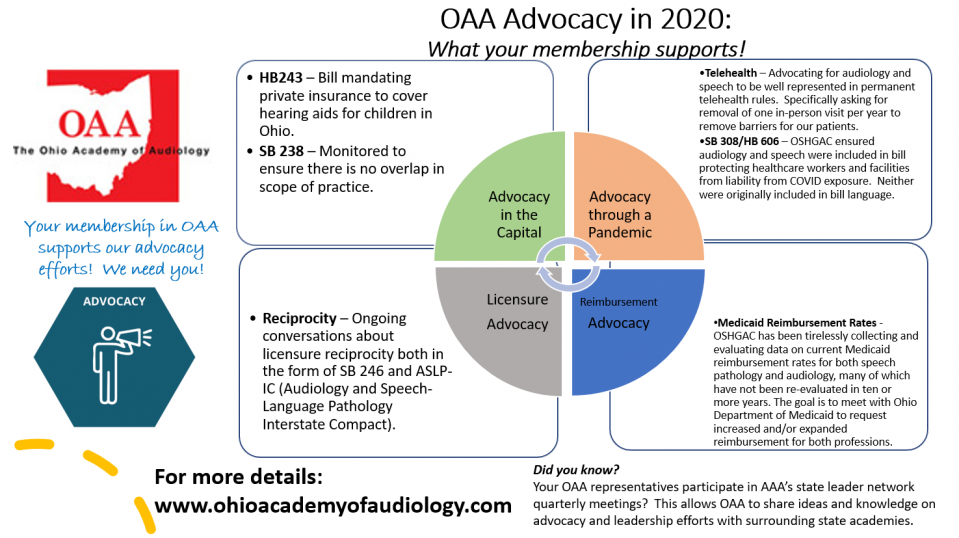
OAA Advocacy In 2020:
What Your Membership Supports!
Things To Know:
OSHGAC: Ohio Speech and Hearing Governmental Affairs Coalition OSHGAC is a collation composed of representatives from Ohio Speech-Language-Hearing Association (OSLHA), the Ohio Academy of Audiology (OAA), the Ohio School Speech Pathology & Educational Audiology Coalition (OSSPEAC) and the Ohio Council of Speech and Hearing Administrators (OCSHA).
Why Partner?
Each group contributes to the cost of a hired lobbying firm, and we work together on issues that impact all of us as united professionals. Each group pays for their own represented membership.
GPG: Governmental Policy Group
Hired lobbying firm that represents OSHGAC by monitoring applicable legislative and regulatory issues and advocating on behalf of the professions of speech pathology and audiology.
For more details:
www.ohioacademyofaudiology.com
Did you know?
Your OAA representatives participate in AAA’s state leader network quarterly meetings? This allows OAA to share ideas and knowledge on
advocacy and leadership efforts with surrounding state academies.